2026-07-08 · 7 min read
Best Free Workout Tracker Apps in 2026 (Ranked)
The word "free" is doing a lot of work in the fitness app market. Most apps that call themselves free have either a crippled free tier, aggressive upsells, or a 30-day trial that quietly becomes a subscription. Finding a workout tracker that is genuinely free — and genuinely useful — takes more digging than it should.
We tested the most popular free workout tracker apps available in 2026 and ranked them on four things: how usable the free tier actually is, how much friction it adds to logging, how well it tracks progress over time, and whether your data stays private. Here's what we found.
What we looked for
Not all workout trackers are built for the same person. A beginner who wants a guided program has different needs than an experienced lifter who just wants to log sets and see their progress. We evaluated each app on the following criteria:
- Free tier usability — can you actually train with it without hitting a paywall?
- Logging speed — how fast can you log a set between reps?
- Progress tracking — does it show you volume trends, personal records, and history?
- Privacy — is your data shared publicly, or kept private?
- Platform — web, iOS, Android, or all three?
Strong
Strong is the go-to recommendation in lifting communities for a reason: it is fast. The logging interface is minimal and purpose-built for getting through a workout without fumbling with your phone. If your priority is speed between sets, Strong is the benchmark everything else is measured against.
The free tier, however, caps you at three custom workout routines. For lifters who rotate through multiple training splits or want to log freely without following a fixed routine, this limit becomes a real constraint within the first few weeks. Unlocking unlimited routines requires a premium subscription or a lifetime purchase.
Strong is iOS and Android. There is no web version. Progress charts and personal records are available on the free tier, which is a genuine plus — you get real tracking without paying. The app has no social features, which most serious lifters prefer.
Best for: Fast logging, strength-focused lifters who follow a fixed routine
The limit: Three routines on the free plan. If you train in a way that doesn't fit neatly into three templates, you'll hit this ceiling quickly.
Hevy
Hevy has built genuine momentum over the last few years, largely because its free tier is more generous than most. Workout logging is unlimited, the exercise library is solid, and progress charts are available without paying. For many lifters, the free version of Hevy is all they'll ever need.
The trade-off is social integration. Hevy is designed around sharing — you can follow other users, see their workouts, and share your own. For lifters who want that accountability layer, it works well. For lifters who find social features distracting or simply want to keep their training private, the interface feels cluttered with features that don't serve them.
Hevy is available on iOS and Android. The free tier is limited to three workout routines — the same constraint as Strong. Premium removes this limit and adds more detailed analytics.
Best for: Lifters who want social accountability and a generous free tier
The limit: Social-first design that gets in the way if you prefer to train privately. Three-routine cap on the free plan.
FitNotes
FitNotes earns a unique spot on this list: it is genuinely, completely free. No premium tier, no subscription, no upsell. If your definition of "free" means paying nothing ever, FitNotes is the only major workout tracker that meets that bar unconditionally.
The trade-offs are significant. FitNotes is Android only — there is no iOS version and no web access. The app has not been actively developed for years, which means no new features and no guarantee of continued updates. Progress tracking is basic: you can see your history for individual exercises, but there are no volume trend charts, no weekly summaries, and no body metrics.
For an Android user who wants a permanent, offline workout log with no strings attached and no features beyond the essentials, FitNotes delivers exactly that. For everyone else, the platform restriction and lack of modern tracking features make it hard to recommend.
Best for: Android users who want a no-cost, no-frills digital training log
The limit: Android only, no longer maintained, no progress charts or body metrics.
NaMiVisa
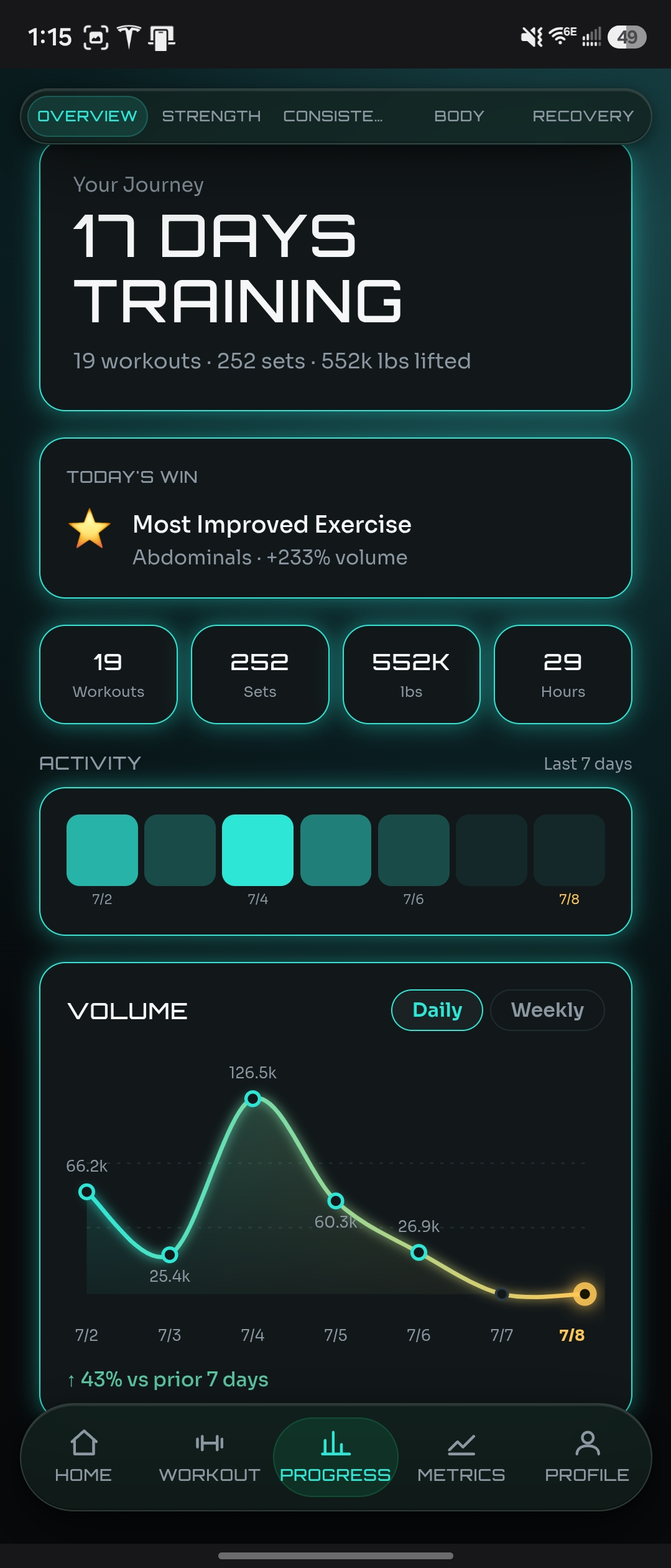
NaMiVisa takes a different approach from the apps above. It is web-based — no app store required — which means it works on any device, any browser, without installation. The entire feature set is available on the free plan, including workout logging, personal records, progress charts, body metrics, and recovery tracking.
The philosophy is also different. NaMiVisa does not require you to follow a program, set up routines in advance, or structure your training in any particular way. You open it, log what you did, and it builds your history automatically. For self-directed lifters who already know what they're doing and just want a fast, private record of their training, this is the core appeal.
Privacy is a first-class feature. There is no social layer, no public profile, and no way for other users to see your data. Your journal is visible to you and no one else. For lifters who find social features in workout apps either distracting or irrelevant, this is a meaningful difference.
Beyond workout logging, NaMiVisa tracks body metrics — weight, body fat percentage, muscle mass, and BMI — and recovery signals including sleep quality, energy, stress, and motivation. These are plotted over time and linked to your training data, so you can see how your body composition and readiness correlate with your volume and consistency.
Best for: Self-directed lifters who train without programs and value privacy
The limit: Web-only for now (native iOS and Android apps are in development). Works well as a mobile web app, but if a dedicated native app is a hard requirement, it is worth noting.
Which app should you use?
The right app depends on how you actually train:
- If you follow a fixed program and want the fastest possible logging interface → Strong
- If you want social accountability and a generous free tier on mobile → Hevy
- If you're on Android and want a truly free, offline log with no extras → FitNotes
- If you train without a program, want full body metrics and recovery tracking, and prefer your data stays private → NaMiVisa
One thing worth noting: Strong and Hevy both cap free users at three workout routines. If you train in a more flexible, free-form way — rotating exercises, running different splits, or not following a template at all — that cap becomes a real problem. FitNotes and NaMiVisa both have no routine limits.
See also
Try the live demo — no sign-up required
Explore months of realistic training data before creating an account.
The bottom line
The best free workout tracker is the one that matches how you actually train. Strong wins on speed. Hevy wins on social features and a genuinely useful free tier. FitNotes wins if you're on Android and want zero cost forever. NaMiVisa wins if you want full-featured tracking — including body metrics and recovery — without templates, a social feed, or a paywall on core features.
All four are worth trying before committing. NaMiVisa has a live demo account loaded with months of realistic training data — no sign-up required — so you can see exactly how it works before creating an account.
NaMiVisa is a free private workout tracker. Learn more →