2026-07-08 · 6 min read
NaMiVisa vs Strong App: Which Workout Tracker Is Right for You?
Strong and NaMiVisa solve the same core problem — logging your workouts and tracking progress over time — but they make very different assumptions about how you train. Strong assumes you follow routines. NaMiVisa assumes you don't. That difference shapes almost everything about how each app works.
This comparison covers what each app actually does well, where each one falls short, and which type of lifter will get more out of each. There is no universal winner — the right choice depends on how you train.
The short version
- Strong is the faster logger — purpose-built for quick set entry between reps
- NaMiVisa is more complete — body metrics, recovery tracking, and progress analytics beyond just lifts
- Strong caps free users at 3 routines. NaMiVisa has no routine limits
- Strong has iOS and Android apps. NaMiVisa is web-based (apps in development)
- Neither has a social feed — both treat your training data as private
Logging experience
Strong is widely considered the fastest workout logging app available. The interface is stripped down to the essentials: exercise, sets, reps, weight. Tapping through a working set takes a few seconds. If you are mid-workout and want to get in and out of the app as quickly as possible, Strong sets the standard.
NaMiVisa is fast too, but it is built for a different kind of session. Because there are no required routines or templates to navigate, you open the app and start logging whatever you are actually doing. You can add any exercise from your library, log any combination of sets and reps, and close the app. The absence of structure is a feature for lifters who train based on feel — there is nothing to fight against.
For pure logging speed inside a fixed routine, Strong has the edge. For free-form training where you decide what to do each session, NaMiVisa removes more friction because it never asks you to fit your session into a pre-built template.
Progress tracking
Both apps track personal records and show your history for individual exercises. Beyond that, they diverge.
Strong focuses on strength progress — you can see your estimated one-rep max over time, your best sets for each exercise, and volume trends. It does what it says it does and does it cleanly.
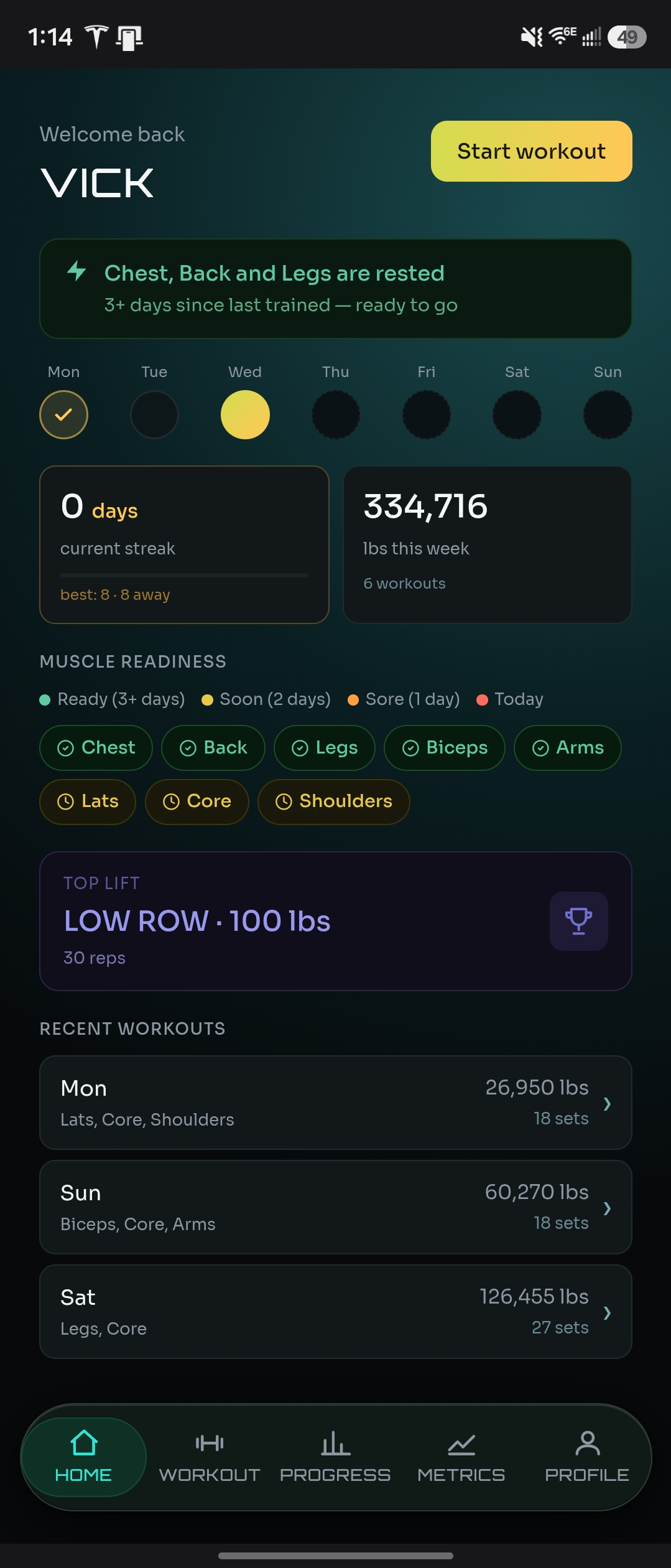
NaMiVisa tracks a wider picture. In addition to personal records and volume trends, it tracks body metrics — weight, body fat percentage, muscle mass, and BMI — and recovery signals including sleep quality, energy levels, motivation, and stress. These are charted over time and linked to your training data. If you want to understand how your body composition is changing alongside your strength, or why some weeks you feel stronger than others, NaMiVisa gives you more to work with.
Pricing and free tier limits
This is where the two apps differ most sharply for a large segment of users.
Strong's free tier limits you to three custom workout routines. For lifters who follow a structured program — say, a push/pull/legs split — three routines is workable. For lifters who rotate through more splits, run different programs across training blocks, or simply do not want to pre-define their workouts, three routines is a hard constraint. Unlocking unlimited routines requires a premium subscription or a one-time lifetime purchase.
NaMiVisa has no routine limit. The full feature set — workout logging, body metrics, recovery tracking, progress charts, personal records — is available on the free plan. There is no premium tier that hides core functionality. For lifters who want complete tracking without paying, NaMiVisa is the more complete free option.
Platform
Strong has dedicated iOS and Android apps. If a native app experience is important to you — offline access, home screen icon, push notifications — Strong has it. The apps are polished and well-maintained.
NaMiVisa is web-based. It works in any browser on any device, including mobile, without installation. You can add it to your phone's home screen and it behaves like an app, but it is not a native app. iOS and Android apps are in development. If you need a native app right now, that is the honest constraint.
Privacy
Both apps keep your training data private by default. Neither has a social feed or a public profile. This is increasingly rare in the fitness app space, and worth noting — both Strong and NaMiVisa are built for individual training, not community performance.
Who should use Strong
- You follow a structured program with a fixed number of training splits
- Raw logging speed is your top priority
- You want a native iOS or Android app
- You train primarily for strength and do not need body metrics or recovery tracking
- You are willing to pay for premium if you exceed three routines
Who should use NaMiVisa
- You train without a fixed program or rotate through more than three splits
- You want to track body metrics and recovery alongside your workouts
- You want full-featured tracking without a subscription
- You prefer a web-based app that works on any device without installation
- Privacy and a clean, distraction-free interface matter to you
See also
Try the live demo — no sign-up required
Explore months of realistic training data before creating an account.
Bottom line
If you follow a program and want the fastest possible set-logging experience on a native app, Strong is excellent — and the free tier is sufficient if you stay within three routines. If you train more freely, want body composition and recovery tracking alongside your lifts, or want the full feature set without paying, NaMiVisa is the better fit.
Both are worth trying. NaMiVisa has a live demo account with months of realistic training data you can explore before signing up — no email required.
NaMiVisa is a free private workout tracker. Learn more →