2026-08-05 · 7 min read
NaMiVisa vs Fitbod: Which Workout Tracker Should You Use?
Fitbod's whole pitch is that it decides your workout for you. Tell it what equipment you have, and before every session it generates a fresh set of exercises based on your training history, your recovery state, and what muscles haven't been worked recently. For lifters who don't want to plan anything, that's a genuinely useful piece of software. NaMiVisa starts from the opposite assumption: you already know what you're doing, and the app's job is to log it fast and show you what's happening over time — not to decide it for you.
Both are solving real problems for real lifters. Here's an honest look at where each one is strong, where each falls short, and what it actually costs to use Fitbod day to day.
The short version
- Fitbod generates a new AI workout before every session, based on your equipment, training history, and recovery — it's the core feature, not an add-on.
- There's no ongoing free tier. Fitbod gives you a 7-day free trial, and after that it's $15.99/month or $95.99/year to keep using the app at all.
- Fitbod's exercise library runs over 1,000 exercises with HD video demonstrations.
- NaMiVisa has no trial that expires — the full tracking feature set is free indefinitely, with no ads and no routine cap.
- NaMiVisa doesn't auto-generate your workouts. If you want a computer planning your sessions for you, that's Fitbod's job, not NaMiVisa's — at least not yet.
AI-generated workouts vs. logging what you already know
Fitbod's AI is the reason people use it. Before each session it builds a workout from scratch — which exercises, how many sets, how much weight — using your equipment list, your training history, and which muscle groups are recovered versus still fatigued from your last few sessions. It's not adapting mid-workout, it's planning ahead of time, but the recovery-aware logic is a real strength: it's genuinely useful for lifters who don't want to think about programming and just want to show up and follow instructions.
NaMiVisa doesn't do any of that. There's no algorithm deciding your session — you open the app, log the exercise, sets, reps, or duration you actually did, and move on. That's a real trade-off, not a workaround: if you want the app to plan your training, Fitbod does that job and NaMiVisa currently doesn't. If you already know how you train and just want a fast, accurate record of it, Fitbod's planning layer is something you'd have to work around rather than use.
Pricing: a 7-day trial isn't a free tier
This is the sharpest difference between the two apps. Fitbod offers a 7-day free trial, and once it ends, the app requires a subscription to keep using it at all — $15.99/month, or $95.99/year if you commit upfront (works out to roughly $8/month). There isn't a scaled-down free version to fall back to the way there is with Strong or Hevy's routine caps. After the trial, it's pay or stop using the app.
NaMiVisa's core feature set — workout logging, personal records, progress charts, body metrics, recovery tracking — has no trial period and no expiration. It's free the same way on day 400 as it is on day one. There's no premium tier gating any of that today; the only paid feature will be an optional AI add-on once it ships (see the next section), and it won't touch anything that already works for free.
Where NaMiVisa's own AI plans fit in
NaMiVisa doesn't have an AI feature yet, and we're not going to pretend it competes with Fitbod's on that front today. What we're building is aimed less at Fitbod's per-session workout generator and more at something closer to a personal trainer's ongoing feedback — using the training history, recovery data, and body metrics you're already logging over months, not just an equipment list and a few weeks of sessions. We're targeting around $3.99/month, as an optional add-on once it ships, not a requirement to use anything that works today.
That's a roadmap item, not a shipped feature. If you specifically want AI-generated session planning right now, Fitbod does that job today and NaMiVisa doesn't — that's the honest state of things.
Exercise library
Fitbod's library is a genuine strength — over 1,000 exercises with HD video demonstrations and muscle-target breakdowns. If you're not sure how to perform something the AI assigns you, there's a video right there. It's built for lifters who want built-in form guidance alongside their programming.
NaMiVisa's exercise library is fully customizable and covers strength, cardio, bodyweight, and timed or distance-based movements, but it's not built around video demonstrations the way Fitbod's is. If in-app form coaching matters to you, that's a real gap on NaMiVisa's side today.
Progress tracking
Fitbod tracks strength progress and shows you trends tied to the workouts it generated for you — useful for seeing whether the AI's programming is actually working. Its focus stays close to the training itself.
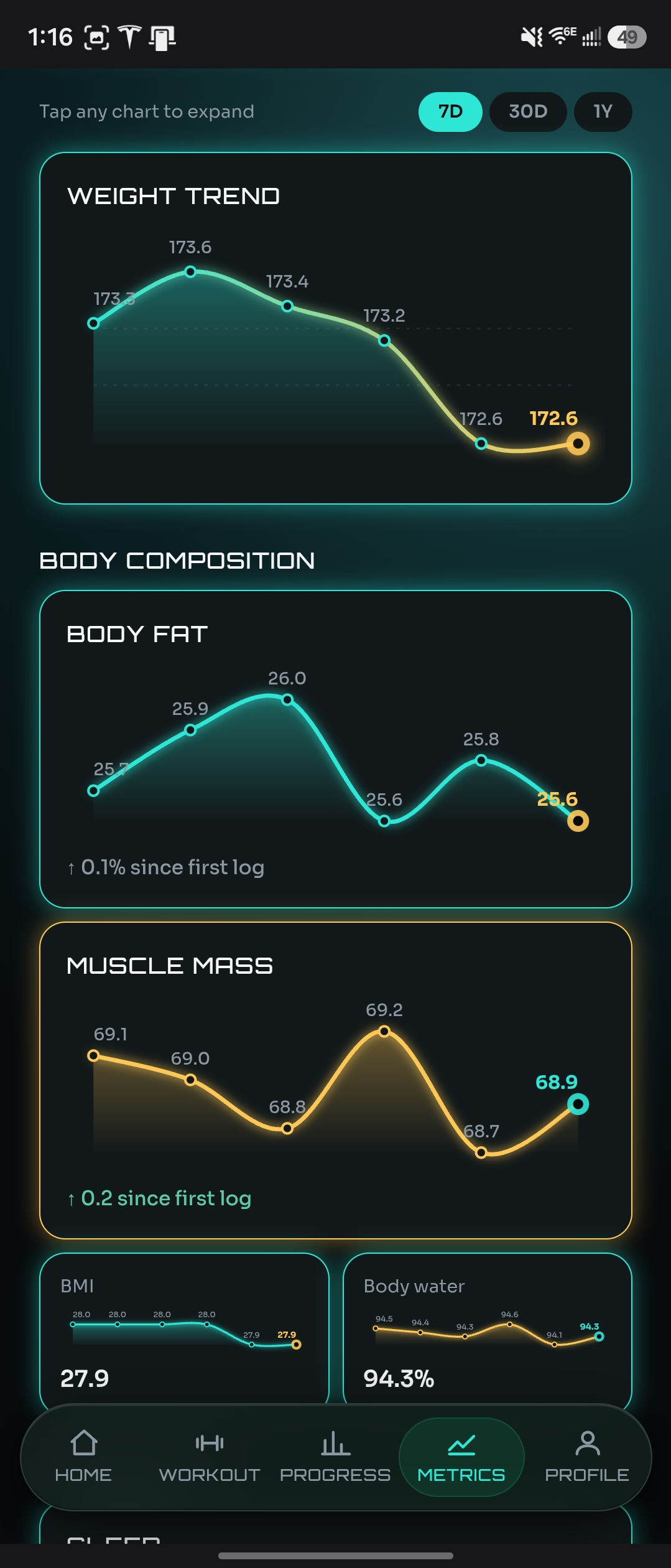
NaMiVisa tracks a wider picture regardless of who planned the workout. Beyond personal records and volume trends, it logs body metrics — weight, body fat percentage, muscle mass, BMI — and recovery signals like sleep quality, energy, motivation, and stress, all charted over time. If you're already using Fitbod's plans but want a clearer picture of body composition and recovery alongside them, that's the kind of data NaMiVisa adds.
Platform
Fitbod has native iOS and Android apps, which is where most of its users train from — the AI planning flow is built around the mobile experience.
NaMiVisa is web-based right now — it works in any browser, on any device, and you can add it to your phone's home screen for an app-like experience. Native iOS and Android apps are in development. If a dedicated mobile app is a hard requirement today, that's the honest limitation.
Who should use Fitbod
- You don't want to plan your own training and would rather an algorithm decide your sets, reps, and exercises each session
- Recovery-aware programming — knowing which muscles are actually rested — matters to you
- You want built-in HD video demonstrations for every exercise
- You're comfortable paying $15.99/month (or $95.99/year) once the 7-day trial ends
Who should use NaMiVisa
- You already know how you train and just want a fast, accurate log — not an algorithm planning your sessions
- You want the full tracking feature set free indefinitely, with no trial clock and no forced subscription
- You want body metrics and recovery tracked alongside your lifts, not just workout history
- You're open to an affordable AI add-on down the road, once it exists, rather than paying for one today
See also
Try the live demo — no sign-up required
Explore months of realistic training data before creating an account.
Bottom line
Fitbod is a strong choice if you want an algorithm planning your sessions around your recovery and equipment, and you're fine paying $15.99/month once the free trial runs out. NaMiVisa is the better fit if you already know how you train and want a complete, free tracking experience — logging, PRs, body metrics, and recovery — with no trial clock attached, plus an affordable AI add-on coming down the road instead of a subscription gate on day eight.
There is a live demo account with months of realistic training data you can explore before creating an account — no email required.
NaMiVisa is a free private workout tracker. Learn more →